
Share this
In the UK, our Christian heritage means that you’re rarely far from a landmark church building, or from one of the thousands of chapels, preaching boxes, warehouses, schools, theatres and cinemas that provide church accommodation across the country.
As our understanding of church shifts and the way we meet together changes, there’s an ongoing conversation about how to manage these architectural assets wisely. What’s the purpose of these buildings now, and who should they serve?
Read on to see how a mission-shaped ethos is changing how we design and adapt church buildings – and the five key groups of people to involve when designing a mission-shaped church building.
Existing church buildings and ‘modern traditional’ church architecture
Over time, church architecture has evolved to suit emerging trends in churchmanship. The medieval church would have been the community centre, market, place of worship and focus of community life; Victorian churches became more formal, Sunday-focused spaces. In recent decades, building have been adapted to include foyers, toilets, offices, and storage (lots of storage!) to provide for the day-to-day life of a healthy church. The need for small meeting rooms has also grown so that spaces can be used flexibly for church and community activities.
In what we could call a ‘modern traditional’ church model, the building typically caters for the busiest usage on Sundays, but can also facilitate outreach and ministry activities throughout the week. The space usage tends to look something like this bubble diagram:
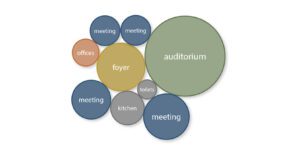
Overall, it remains a church-centric model: optimum capacity for Sunday meetings with a peripheral community resource.
Emerging church design: Mission-shaped buildings
Moving away from the ‘modern traditional’ template, a new kind of design is emerging: an architectural response to real needs expressed by the church’s local community.
Imagine a church that includes a pharmacy or affordable housing for key workers, a community kitchen, or a furniture warehouse. In an area where one or more of these resources are desperately lacking, a church could reinvest in its building for maximum impact in the local neighbourhood.
There is no limit to the combination of spaces that could represent this ‘modern contemporary’ building, but it could look something like this:
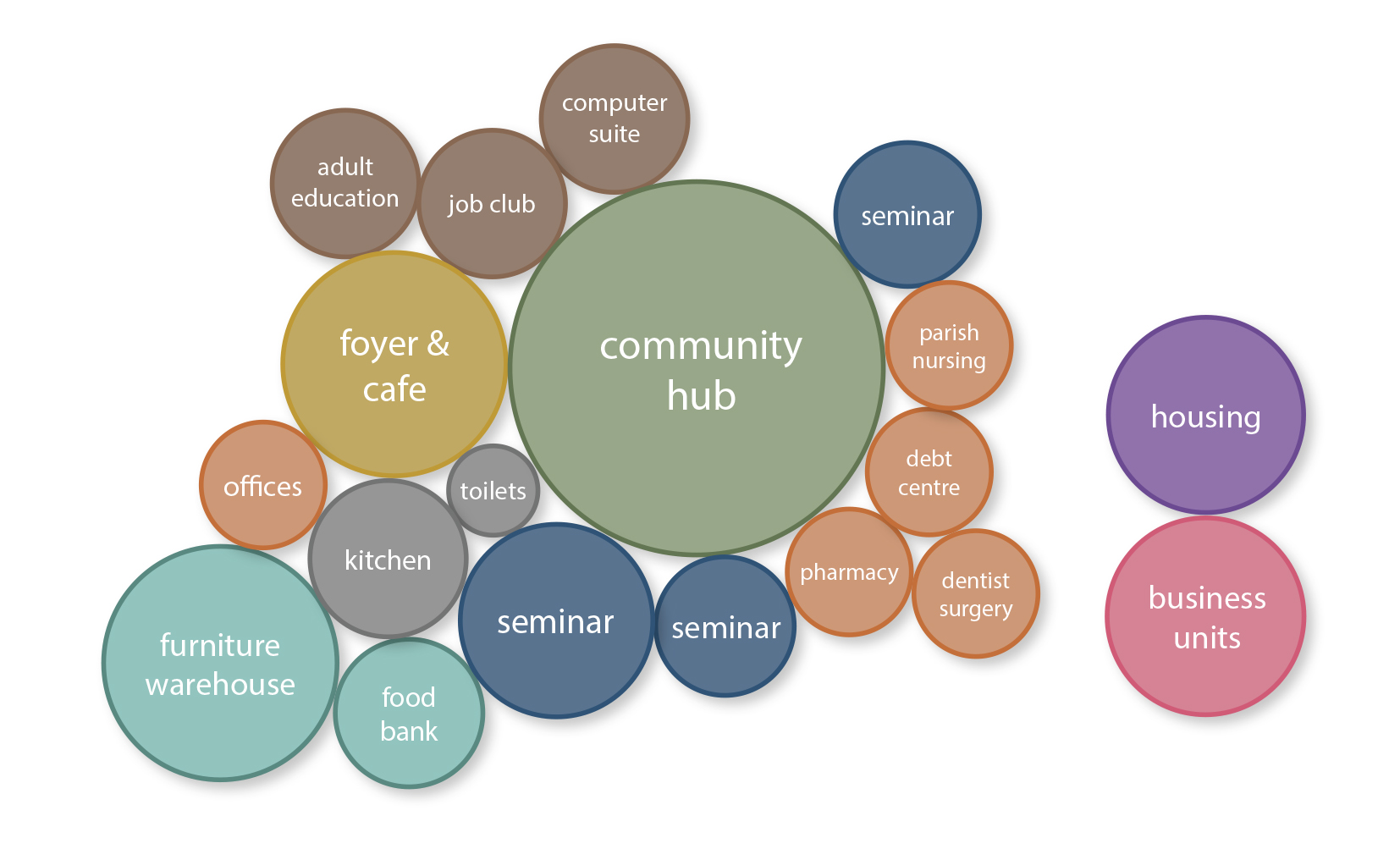
Instead of replacing one church building template with another, a mission-shaped approach can lead to all sorts of different expressions of church building, turning the church-centric model upside down.
In this context, there are huge benefits to church architects developing a portfolio of projects beyond churches – by drawing on experience from residential, commercial, healthcare and educational building design, fresh ideas can be creatively incorporated to resource the mission of the church.
These mission-shaped buildings are game-changers for our understanding of church and our appreciation of good church architecture.
Should we still commission new church buildings?
When Jesus commissioned his church to go and make disciples of all people groups, baptising them and
teaching them all he taught, he didn’t say: ‘And also build church buildings’. While church congregations have always needed spaces to gather, a thriving church doesn’t have to own the space it meets in, as the early church made clear. Peter didn’t respond to Pentecost by finding a team of builders to create a 5000-seater amphitheatre. Instead, the explosion of church growth we see in Acts was distributed to homes and existing public places for worship, teaching and fellowship. This raises interesting questions for a Christian architectural practice! At Leap Architects, while we don’t have all the theological answers to justify investment in bricks and mortar, we have a missional ethos to all we do. Our motivation is the people who haven’t yet encountered Jesus in a life-changing way.
Where a church does own or have use of buildings (in whatever form they take), these can be used as Kingdom assets in 3 key ways:
Where a congregation inherits a building which is not designed or equipped for this kind of community vision, it can be a hindrance to the work of the church – and may be the starting point for exploring a new building design.
Five key groups of people to ask about your church building project
If it is the right time for a church building project, it’s essential to get to know the neighbours. Whether large or small, a building project can be rewarding (definitely faith-building!) and provides opportunity to build relationship with the wider community in profound and unexpected ways. Over 20 years’ experience in working with church and community groups has led us to develop a design service that is tailored to this unique clientele. Whenever we work with churches through our Neighbours survey, there are five key groups we believe need to hear be heard:
What’s the future of UK church buildings?
Managing architectural assets wisely is an ongoing challenge for churches, but when we look outside the walls and get to know the neighbours, we can start to reimagine church buildings together.
More and more, we see churches beginning an architectural project by asking their communities ‘What do you need?’ and allowing the answers to significantly influence the finished design.
There are so many gaps that the church could fill; in social provision, developing community relationships, or assisting with specific needs. It’s exciting to see church buildings becoming places of deeper community connection, maximising the impact of the gospel in the local areas they serve.
Interested in exploring how a Neighbours survey could work for your church? Find out more here.